I had visited Snapper Creek a few weeks ago and bought a new camera at the Best Buy, adjacent to the river and taken a memorable piture of a Halloween Pennant. Today with yet another new camera, the Canon 50D, I was hoping to recreate that success.
As I approached the river, I noticed a Great Egret and 2 White Ibis close to the water's edge. A pair of large iguanas were moving towards the sunlit grass.
Snapper Creek is approx 8 meters wide at this point and has 2 or 3 meters of grass on both banks. The margins have grass and a few other emergent plants. In some spots, mats of weed cling close to the banks. The water is very clear and has a good flow. There are many fish, some quite sizeable.
The first ode was seen from the Northern bank right beside the bridge at Dadelands North Metrorail station.  It was a Scarlet Skimmer, Crocothemis servilia. This dragonfly has appeared in the blog before and today takes the crown for the most widespread ode that this blogger has seen. First seen in Singapore, it has subsequently been found in Hong Kong, where it goes by the name of Crimson Darter, and in India during October.
It was a Scarlet Skimmer, Crocothemis servilia. This dragonfly has appeared in the blog before and today takes the crown for the most widespread ode that this blogger has seen. First seen in Singapore, it has subsequently been found in Hong Kong, where it goes by the name of Crimson Darter, and in India during October. The website Odonata Central has very little to say about this species, which I found surprising for such an apparently abundant and dramatic-looking creature. This leads me to wonder if it has been introduced or escaped along with the iguanas and the parrots. Despite it's uncertain provenance, it is quite approachable and sits well for pictures.  Without any evidence to the contrary, I am assuming this to be the female.
Without any evidence to the contrary, I am assuming this to be the female.Next was the tiny, Spot-tailed Dasher.  Another seemingly abundant species, which also fails to make it into the "Beginner's Guide to Dragonflies", which I am currently using as my reference field-guide.
Another seemingly abundant species, which also fails to make it into the "Beginner's Guide to Dragonflies", which I am currently using as my reference field-guide.The little dasher was then displaced by the much larger, Blue Dasher.  The Blue Dasher was the original holder of the distribution title having been seen from Toronto, Canada to Califonia.
The Blue Dasher was the original holder of the distribution title having been seen from Toronto, Canada to Califonia. Then came the dragonfly which had been at the back of my mind when I had chosen to come to Snapper Creek. I had taken a picture of it for the previous Miami post, but it had not been sufficiently detailed to allow me to properly identify it.  I can now reveal that it is a Tawny Pennant, Brachymesia herbula. I was beginning to suspect that the Stokes's had forgotten to visit Florida while researching their book as 3 out of 4 odes seen so far had been omitted. Despite that, the guide will probably please most people who don't get anal about identifying down to the sub-special levels.
I can now reveal that it is a Tawny Pennant, Brachymesia herbula. I was beginning to suspect that the Stokes's had forgotten to visit Florida while researching their book as 3 out of 4 odes seen so far had been omitted. Despite that, the guide will probably please most people who don't get anal about identifying down to the sub-special levels.I doff my hat to Warwick and Michele Tarboten for this next photo. I would not have even considered taking a shot, were it not for the photo on the back cover of their "A Fieldguide to the Damselflies of South Africa". Now, if ever you are considering writing an Odonata fieldguide, may I suggest this as a standard to which you should aspire.  I believe it to be a Rambur's Forktail. This species is mentioned by the beginner's guide, but when you do not have the full set for comparison, how can a definitive identification be made?
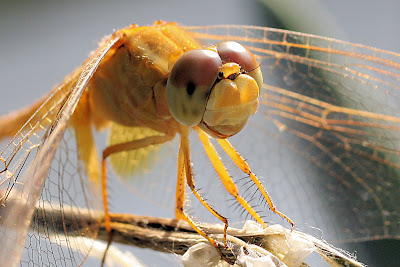
I believe it to be a Rambur's Forktail. This species is mentioned by the beginner's guide, but when you do not have the full set for comparison, how can a definitive identification be made?And so to the one that got away. This was my best pictuere of the day which makes it frustrating not to get a positive ID. My suspicions lead me towards a female Eastern Amberwing. It was about the right size and the abdomen is suggestive of amberwing. The eyes and the yellow marks on the thorax fit the descriptions of the amberwing. The wings however made me doubt the accuracy of my assumptions. The creature left it's wings to flutter in the light breeze in the same way that I had seen the Halloween Pennant doing on my previous visit. The wings were also much more heavily marked than I have seen in any photos or illustrations. There were both Eastern Amberwings and Halloween Pennants in the vicinity to compare size and flutteriness with. I see that the amberwings sometimes imitate wasps, but the fluttering did not seem reminiscent of any wasp that I had seen before. So I find myself unsatisfied with Eastern Amberwing. Perhaps there is a tiny pennant that I have not found in my research yet. All thoughts are welcome.
It was about the right size and the abdomen is suggestive of amberwing. The eyes and the yellow marks on the thorax fit the descriptions of the amberwing. The wings however made me doubt the accuracy of my assumptions. The creature left it's wings to flutter in the light breeze in the same way that I had seen the Halloween Pennant doing on my previous visit. The wings were also much more heavily marked than I have seen in any photos or illustrations. There were both Eastern Amberwings and Halloween Pennants in the vicinity to compare size and flutteriness with. I see that the amberwings sometimes imitate wasps, but the fluttering did not seem reminiscent of any wasp that I had seen before. So I find myself unsatisfied with Eastern Amberwing. Perhaps there is a tiny pennant that I have not found in my research yet. All thoughts are welcome.Odonata species; 8
Rambur's Forktail 12, Eastern Meadowhawk 4, Eastern Amberwing 6, Scarlet Skimmer 8, Spot-tailed Dasher 8, Blue Dasher 2, Tawny Pennant 12, Halloween Pennant 1,


 A dragonfly was perched on an aloe-type plant. I suspect it was a female or juvenile of the darker, redder ode below.
  They both exhibit similar blotches at the bases of the wings.
 This particular species was very common in this locale with hundreds of them in the meadows and the wet margins of the lake. It is very reminiscent of a Crimson Darter, Cocothemis servilia, but I have nothing else to compare it to. It is duller than previous encounters with C.s.
 I had ordered a book that I hoped would enable me to identify some of the common odonata of India. It arrived while I was away, but on opening it on my return, I found it to be quite useless. The illustrations were childlike and photos were poorly printed. So I find myself throwing the identifications open to anyone who can help.
 In terms of quantity it was dramatically outnumbered by all the others today.
 It is a very widespread dragonfly that is distributed from Europe to Australia and all points between, taking in Russia and North Africa on the way.
 The skimmer was very approachable and allowed me to get close to him with the 50mm macro lens.
 A similar-looking dark dragonfly could be related. It’s general appearance seems very close to the percher’s, but we all know how similar some other forms of odonata are, so I am not taking anything for granted.
  Both of them seemed to be weak fliers, resting after short forays.
 A pair of ponds in the northeast sector of the park should have been very productive at the right time of day, but I passed through too early. They would be worth a look when the sun is higher on my next visit.
 Grenadier Lake was teeming with Blue Dashers, which are fast becoming the most widespread odonata for this observer so far.
  On this occasion, I saw that the wings were more shaded than I had previously noted. The specimens that I had observed in LAX, MIA and PHX had been much cleaner of wing.
 These belonged to the Eastern Meadowhawk.
 Here I met the female Eastern Meadowhawk. Thinking I had a new species, I was determined to get a good photo and she proved to be very obliging. She had caught and was eating a small, blue fly It was at this point that I checked my “remaining frames” counter and saw that it had hardly changed. I had set the definition very low last week and had not changed it back. All of the pictures taken this week have been at 1mb or less. Changing the resolution back to high, the pictures were over 4mb.
 The definition is compromised when put onto the blog, so the difference would only be obvious when the subject is heavily cropped, but it is very noticeable on the monitor with the full size picture.
 A Green Darner settled into the grass for a close-up. A saddlebags flew over in silhouette but I am not yet proficient enough to tell which.
 This one could be a Familiar Bluet, but I am going to need more practice identifying before I claim him in red.
  The rocks created a semi-dam across part of the stream and allowed me to get out into the middle of the river and look back towards the bank. Two forms of what I assumed must be pennants of some sort were dog-fighting with each other over the shallow bend in the stream.
  One was the male of the Common Whitetail. They would settle from time to time, but at a distance, so I had to get my feet wet and muddy again to get close enough for a picture.
 This one is a
  On some floating mats of weed, were a couple of different zygoptera. They were very common in the muddy bay, laying eggs among the weeds.
  I now know that one of the damselflies was an
  It proved to be a
  There is a lot of controversy and confusion about red meadowhawks. A number of species are very similar and cannot safely be separated in the field.
 So unless anyone can tell from this photo, it will remain a mystery.
 but sadly, so do Green Herons.
  Eastern Amberwings and Blue Dashers were very common. Soft floating weed provided ovipositing opportunities and even a feather sufficed as a perch in the absence of anything else at the formal end of the lake.
 There is a confusing set of bluets that ought to be examined in the hand for definitive identification. I think that this is possibly a Familiar Bluet, but since it has such close look-alikes, this may prove a hasty assumption.
 It has a 24x optical zoom. By some jiggery pokery, the tech specs claim this equates to 26-624mm on a 35mm format SLR camera. My DSLR has a sensor which is smaller than 35mm and thereby produces a cropping effect. This is how my 400mm appears to be 640mm.
 I bought the camera from a shop beside a small river near Dadeland Mall. In a stretch of less than 50m of riverbank, I saw 9 different types of dragonflies. Most of them have yet to be identified, but there is enough detail here to confirm that it is a Halloween Pennant.
 To my mind, I think it is an oversight not to provide a remote release facility. With 624mm of throbbing focal length, I would have to use a tripod and with a tripod, I like to use a remote release. It is true that no other compact digital cameras provide the feature either, but why not? Digiscopers have had to develop grips and frames and pushers and pressers in order to achieve what is really a very simple function if built in at the design stage.
 We were staying at Meia Praia in Lagos in the western Algarve. Betweeen our hotel and the beach is an area of dunes. A boardwalk ensures as much as possible that the dunes receive a small level of protection from the eager feet making for the beach.
  Grass and plants growing from the dunes provided perches for a good number of
 It was a dribble that was used to water a tied-up horse, but it was permanent and just big enough to hold odonata. In fact, I was surprised by the number of species in such a small microcosm.
 First and most obvious was a
  I found a tiny
  The
The  He is supposed to only rarely settle on the ground, yet this one seemed to prefer the ground to perching on any of the numerous available raised vantage points.
  The pinched abdomen was very obvious and I ended up wondering why I doubted myself.
 Below the dam at the base of the wall a tiny dribble provides enough water for life to exist in the deeper holes of the outflow stream. Again, the profusion of odonata in such a small area surprised me.
  All of the anisoptera were repeated here and the new one was the
  Not wanting to tick it retrospectively without any supporting evidence, it was worth the long climb up and down the wall of the dam.
 The Lesser Emperor was again restless and did not seem inclined to stop for a picture until I saw one across the puddle, settle on a stalk.